
So far in this series, we’ve looked at four common traps:
- relying on reports to make portfolio decisions
- setting priorities without checking capacity,
- and asking teams for too much detail too soon,
- treating portfolio agility as a choice between annual planning and constant reaction.
The fifth trap is assuming that portfolio alignment requires every team to work the same way.
That assumption is understandable. When leaders cannot get a clear view across the portfolio, the problem can look like a tooling problem. Some teams work in Jira. Others plan in Smartsheet, MS Planner, Asana, spreadsheets, or lighter processes. Each team has its own way of structuring work, estimating effort, tracking progress, and managing delivery.
From a portfolio perspective, that can feel messy. So the organization looks for order by trying to standardize the way work is managed. The intent is good. Leaders want one reliable view of what is happening, what is planned, and what needs attention.
The risk is that standardization can turn into tool-enforced micromanagement. Instead of improving portfolio decisions, the organization spends its energy trying to make every team fit the same operational model.
Different Tools Are Not the Real Problem
It is easy to blame the tools. When portfolio information is scattered, the obvious answer seems to be: put everyone in the same place. One tool. One structure. One place to look.
For some organizations, that may sound simpler. If every team works in Jira, maybe leadership can finally see everything. If every initiativeInitiativeSynonym for → ProjectA project is a time-limited undertaking with defined objectives and resources that delivers unique results and often includes complex tasks. is broken down the same way, maybe reporting becomes easier. If every team follows the same process, maybe portfolio planningPortfolio PlanningPortfolio planning is the process by which companies decide which projects they want to carry out. This ensures that projects are in line with the company’s objectives and that the… becomes more reliable.
In practice, it rarely works that cleanly. Different teams use different tools for a reason. A software team working in Jira may need detailed backlog management, sprint planning, and delivery tracking. A business team may manage work in a lighter planning tool. A shared service team may need a spreadsheet or resourceResourceResources are all the people, places and things that you need to complete projects. The most important resource? Employees, of course! plan. Some teams may work in structured agile methods, while others use hybrid or more traditional delivery approaches.
Forcing all of those teams into one task-tracking structure can create new problems. Teams lose the flexibility to work in the way that fits their work. Portfolio managers still have to translate details from one level of planning to another. Leadership may get more data, but not necessarily better decisions.
Teams working differently are not the real obstacle. The bigger gap is the lack of a shared way to make portfolio decisions across those differences.

Tool Uniformity Can Create the Wrong Kind of Control
Standardizing tools can feel like progress because it creates visible order.
Fields match, workflows look familiar, and dashboards become easier to build. The portfolio can seem more organized because more work appears in one system.
That kind of order can be useful for reporting, but it does not automatically solve the portfolio problem. Portfolio leaders are not trying to manage every taskTaskSynonym for → ProjectA project is a time-limited undertaking with defined objectives and resources that delivers unique results and often includes complex tasks.. They are trying to decide which initiatives should move forward, when they should happen, and which people or roles are needed to make them realistic. Those decisions require a different level of information.
If the organization focuses too much on task-level uniformity, it can end up asking the wrong questions. Are all teams using the same issue types? Are estimates captured in the same format? Are workflows aligned across departments? Are teams updating the same fields?
Those questions may help with administration. They do not necessarily help leadership decide what should be selected, delayed, stopped, or resourced.
In the worst case, the push for uniformity creates resistance from the teams doing the work. They feel like portfolio management is imposing process for the sake of control, rather than helping the organization make better decisions.
Why This Happens in Jira Environments
This problem shows up often in organizations using Jira because Jira is where many delivery teams manage important work.
For teams that manage delivery in Jira, it is a valuable system. It helps them organize backlog items, epics, sprint plans, dependencies, status, and progress. It gives delivery teams a working view of what needs to happen next.
The challenge comes when Jira is treated as the answer to every portfolio question. A Jira board can tell you a lot about delivery activity. It can show what a team is working on, what is planned, and what has moved forward. It does not automatically create a shared portfolio view across teams that use different tools, different levels of detail, or different delivery methods.That matters because portfolio decisions are not made at the same level as team execution.
Leadership needs to compare initiativesInitiativesSynonym for → ProjectA project is a time-limited undertaking with defined objectives and resources that delivers unique results and often includes complex tasks. across the organization, understand timing, look at resourceResourceResources are all the people, places and things that you need to complete projects. The most important resource? Employees, of course! needs, and see trade-offs. Those decisions need information from Jira, but they also need information from teams and systems outside Jira.
When the organization tries to solve that by forcing everyone into the same Jira structure, the portfolio process can become too focused on tool alignment. The real need is broader: a way to translate different types of delivery information into a common portfolio view.
The Better Question
Instead of asking, “How do we get everyone into the same tool?” ask, “What shared language do we need to make decisions across teams?”
A useful portfolio language does not require every team to manage work the same way. It focuses on the few things leadership needs in order to steer the portfolio: which initiativesInitiativesSynonym for → ProjectA project is a time-limited undertaking with defined objectives and resources that delivers unique results and often includes complex tasks. are being considered, when they might happen, which teams or roles are needed, what capacity is available, and what trade-offs a decision would create.
These considerations sit above the level of individual tasks. They give leaders a way to compare work across tools without forcing every team into one delivery process.
That shared language also creates a healthier relationship between portfolio management and team execution. Teams can continue to use the tools and methods that fit their work. Leadership gets the structure it needs to make decisions across the portfolio.
What This Looks Like in Practice
Imagine an organization where some teams work in Jira, others use Smartsheet or MS Planner, and a few still plan in spreadsheets.
A new initiativeInitiativeSynonym for → ProjectA project is a time-limited undertaking with defined objectives and resources that delivers unique results and often includes complex tasks. is proposed. The portfolio team does not ask every group to rebuild its work in the same system or provide the same level of task detail. Instead, the initiative is captured in a common portfolio format.
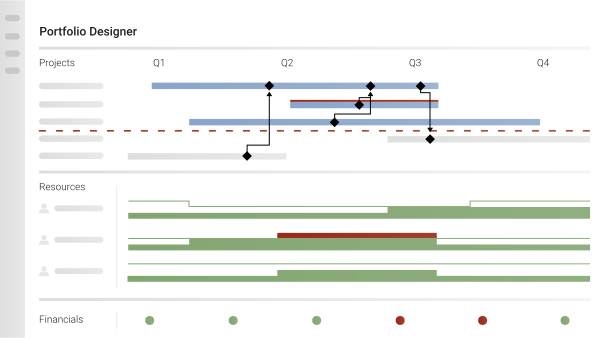
The portfolio view shows the initiative’s goal, priority, likely timing, resourceResourceResources are all the people, places and things that you need to complete projects. The most important resource? Employees, of course! needs, major dependencies, and current status. Delivery details can stay where they belong. Jira teams can continue managing epics and sprint work in Jira. Other teams can continue using the tools that fit their way of working.
What changes is the decision layer above those tools. Leadership can compare the initiative against other work. They can see whether the timing is realistic, whether the right roles are available, and what would need to move if the initiative is approved. The conversation becomes less about where the data lives and more about what decision needs to be made.
This is where unity matters more than uniformity. Instead of making every team work the same way, the organization creates one shared way to make decisions across work that is managed differently.
Why This Matters
Portfolio management should help the organization deliver better. It should not force every team into the same operational mold.
When unity is confused with uniformity, portfolio management can become a source of friction. Teams feel pressured to change tools or processes for the sake of reporting. Leaders still struggle to make decisions because more taskTaskSynonym for → ProjectA project is a time-limited undertaking with defined objectives and resources that delivers unique results and often includes complex tasks. data does not automatically create a clearer portfolio picture.
A shared portfolio language solves a different problem. It gives leadership a common way to discuss selection, timing, resourcesResourceResources are all the people, places and things that you need to complete projects. The most important resource? Employees, of course!, and trade-offs across the entire organization. It respects the reality that teams work differently while still creating the structure needed to steer.
That is especially important in organizations using Jira. Jira can remain the right place for delivery teams to manage execution. Portfolio management needs to sit above that, connecting Jira data with the rest of the organization so leaders can make decisions across all work, not only the work that fits neatly into one tool.
Variation does not need to disappear. The organization just needs enough shared structure to make better decisions without forcing every team to work the same way.
Want to Go Deeper?
This is the fifth of five patterns that make portfolio decisions harder than they need to be.
In our full white paper, Avoiding the Downward Spiral of Portfolio Management with Jira Data, we break down:
- what’s not working in portfolio planningPortfolio PlanningPortfolio planning is the process by which companies decide which projects they want to carry out. This ensures that projects are in line with the company’s objectives and that the… with Jira data,
- why these problems keep happening,
- and how organizations can build a better portfolio and resource planning process around Jira.
Read Next


Why Annual Planning Alone Isn’t Agile, and Ad-Hoc Decisions Aren’t Either
In the fourth post of this five-part series on portfolio planning with Jira data, we look at why organizations need a regular portfolio decision cadence that balances strategic agility with team focus.

From Manual Resource Planning to Reliable Resource Management
Learn how Sulzer GmbH established data-driven management of its project business with Meisterplan.