

In the first post of this series, we looked at why portfolio reports aren’t enough to make decisions. Reports help you see where work stands, but they do not give you the full, forward-looking picture you need to make confident portfolio decisions.
This post looks at the next problem: prioritization without capacity.
Most organizations do prioritize. They rank requests. They assign labels. They mark work as urgent, strategic, high-value, or “must-have.” They may even have a formal intake process or scoring model to make those decisions feel more objective, which is useful. However, if those priorities are not connected to capacity, they do not tell you what can actually happen. They only tell you what everyone hopes will happen.
Ranking Work Is Not the Same as Making a Plan
It is easy to think prioritization is the hard part. After all, getting leaders to agree on what matters most is not exactly simple. There are competing goals, customer commitments, internal initiatives, product needs, budget constraints, and plenty of opinions.
So when something finally gets ranked as a top priority, it can feel like the decision has been made. Yet, ranking work only answers part of the question because capacity determines whether that priority can realistically move forward.
Work does not become realistic just because it is important. It becomes realistic when you can see who needs to do it, when they are available, and what else they are already committed to.
Without capacity, “top priority” becomes a label. Labels do not create more people, remove existing commitments, or solve bottlenecks waiting three teams downstream.

Where Jira Data Helps, and Where It Doesn’t
If your teams use Jira, you probably have a lot of useful information about execution. You can see epics, issues, sprints, dependencies, status, and progress inside individual teams or boards. For delivery teams, that visibility matters.
Portfolio prioritization happens one level higher. You are not only asking whether work is moving through Jira. You are asking whether the right work is moving, whether the organization can take on more, and what has to change if priorities shift.
This becomes especially difficult when Jira is only part of the picture. Product or engineering may plan in Jira, while marketing, operations, IT, or other teams use Smartsheet, MS Planner, Asana, spreadsheets, or their own planning process. Work may be visible inside each team’s tool, but capacity is still hard to see across the portfolio.
So a new initiative gets approved because it is important. Then the real question appears: Who is actually available to do it? If the answer is “no one,” the priority list does not help much.
What Happens When Everything Is Important
When priorities are not connected to capacity, teams are left to absorb the conflict. They keep working on what has already been approved. They try to make progress on a new urgent request. They respond to leadership pressure. And they make trade-offs in the background, often without a clear portfolio-level decision about what should move, wait, or stop.
That is when “top priority” starts to lose meaning. If five things are top priority, and the same people are needed for all five, then the organization has not really prioritized. It has overloaded the system.
Once that happens, the symptoms are predictable. Work slows down. Deadlines slip. Teams context-switch. Leaders ask for updates. More meetings get added. More reports get built.
Yet, the core issue remains the same: the plan does not match the available capacity.
The Real Capacity Question
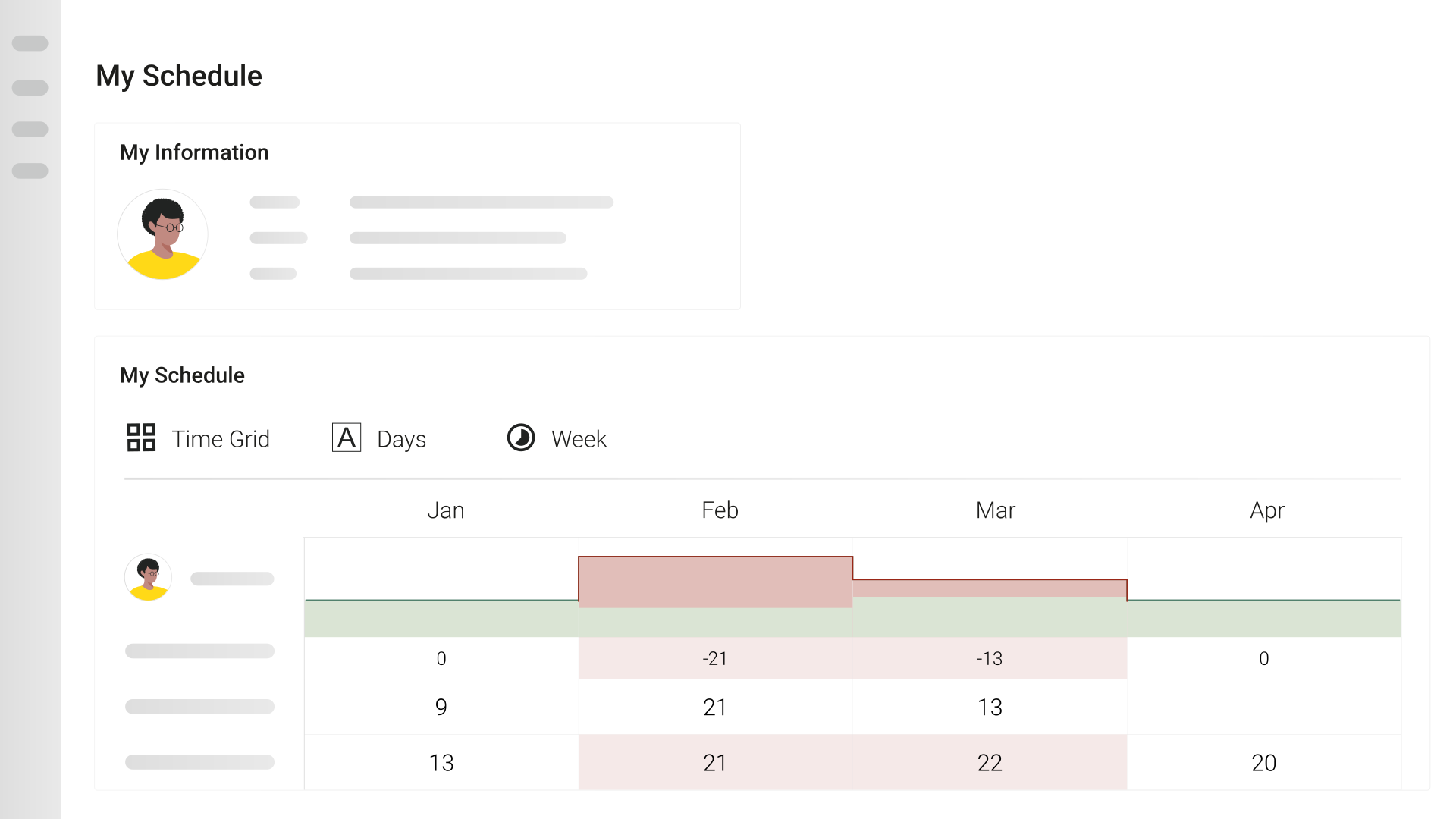
Prioritization has to move beyond ranking. The question is what matters most given the people, timing, and capacity you actually have.
Capacity cannot be something you figure out after priorities are set. It has to be part of the priority decision itself.
Before you say yes to new work, you need to know whether the priority is realistically deliverable. You need to look beyond how important the work is to check whether the people, roles, and teams needed to deliver it are realistically available.
This does not require perfect estimates. At the portfolio level, you usually do not need task-level detail to make the next decision. You do need enough visibility to know whether the priority is feasible.
Prioritization Should Create Focus, Not More Overload
The point of prioritization is to create focus. In practice, focus means deciding what should happen now, what should wait, and what should no longer take capacity. Sometimes it also means saying no to work that is valuable because the capacity is not there yet. That is uncomfortable, but it is also what makes prioritization meaningful.
Otherwise, every new priority gets added on top of everything else. The burden moves from leadership to the teams, and they are left figuring out how to deliver more than is realistically possible.
What This Looks Like in Practice
In practice, capacity-aware prioritization means every priority decision includes a feasibility check before the commitment is made.
You are not just asking, “Is this important?” You are asking, “Can we actually do this, and what changes if we say yes?”
For teams working in Jira, that might mean connecting planned epics or initiatives to the people and roles needed to deliver them. For teams working outside of Jira, it means bringing their work and capacity into the same portfolio view, so the decision is not based only on the teams with the cleanest data.
A new request is no longer evaluated in isolation. It is evaluated against everything already in motion: current commitments, constrained teams, timing, and the flexibility you actually have.
You can still choose to take on urgent work. You can still make exceptions. You can still decide that something is important enough to disrupt the plan. Now you are making that decision with a clearer view of the impact. You can see the trade-offs and explain why one decision is better than another.
Why This Matters
A better portfolio process connects priorities to capacity from the start. Instead of only determining whether something is important, you determine whether you can commit to it without pretending the constraints do not exist. That is what turns prioritization from a ranking exercise into a real portfolio decision.
Want to Go Deeper?
This is just one of five patterns that make portfolio decisions harder than they need to be.
In our full white paper, Avoiding the Downward Spiral of Portfolio Management with Jira Data, we break down:
- What’s not working in most portfolio processes
- Why it keeps happening
- And what to do differently
Read Next


Agile or Top Down Project Management? The Answer: Hybrid Project Management
What is behind the hype about agile work? And what really works? In this blog post, we answer these and other questions and explain the challenges that management faces and how you can solve them.

Are People Resources? – Why Do We Call Employees Resources?
What exactly does it mean to call people resources? We break down why the term is used and when it's appropriate to call people resources.