

Meisterplan uses its own software to strategically manage Meisterplan’s development, prioritize projectsProjectA project is a time-limited undertaking with defined objectives and resources that delivers unique results and often includes complex tasks., and realistically plan available team capacity. Portfolio planningPortfolio PlanningPortfolio planning is the process by which companies decide which projects they want to carry out. This ensures that projects are in line with the company’s objectives and that the… takes place in Meisterplan, while the developers organize practical implementation in Jira. A recurring Lean PPMLean PPMSynonym for → Lean Project Portfolio ManagementLean Project Portfolio Management (Lean PPM) is a lightweight framework for managing an organization’s project portfolio. It helps determine which projects to run, when to run them, and with which… process links strategic goals, project evaluation, resource planning, agile implementation, and performance measurement. According to our portfolio managers, this results in approximately 95% of projects being completed successfully.
A complete overview of your portfolio and reliable planning, even when teams work agile? At Meisterplan, that’s exactly what we do with our own software.
“Coordinate many projectsProjectA project is a time-limited undertaking with defined objectives and resources that delivers unique results and often includes complex tasks. across many teams with Meisterplan, no matter which tools or methods they use.” That’s not just the promise Meisterplan makes to prospective customers of its project portfolio and resource managementResource ManagementWhen it comes to resource management, the focus is on the optimal planning, coordination and monitoring of resources. The term “resources” includes things like employees, budgets, materials and time. software. It’s also the approach Meisterplan takes as an agile software company. To develop Meisterplan, we use our own software alongside a variety of integrationsIntegrationAn integration is a virtual interface that connects different software programs and enables automated data exchange between them. This allows for more efficient processes, better planning, and consistent information. and methods. Meisterplan itself operates at the portfolio level, while our developers use Jira for execution.
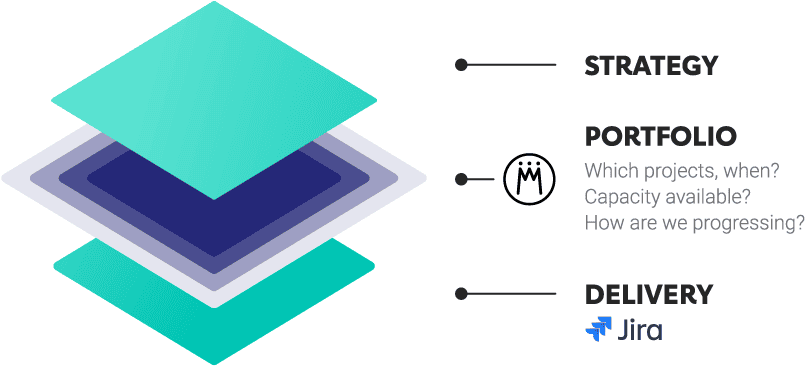
This sounds great in theory, but it also has to work in practice. So let’s take a look behind the scenes of agile software development at Meisterplan and answer the following questions:
- What role does strategy play?
- How do new topics that we want to implement make it into the portfolio?
- How do we decide what gets built when, and which teams work on it?
- How do we connect execution in Jira and portfolio planningPortfolio PlanningPortfolio planning is the process by which companies decide which projects they want to carry out. This ensures that projects are in line with the company’s objectives and that the… in Meisterplan?
- How do we measure the success of our projects?
To continuously make decisions throughout every phase of a project, Meisterplan uses the Lean PPMLean PPMSynonym for → Lean Project Portfolio ManagementLean Project Portfolio Management (Lean PPM) is a lightweight framework for managing an organization’s project portfolio. It helps determine which projects to run, when to run them, and with which… framework we developed ourselves. Lean PPM is a lightweight decision-making framework for allocating limited employeeEmployeeSynonym for → ResourceResources are all the people, places and things that you need to complete projects. The most important resource? Employees, of course! capacity across many competing projects. At Meisterplan, the necessary decisions are made in a series of meetings. But before individual project decisions can be made, there has to be an overarching strategy.
Who and What Is Meisterplan?
Meisterplan is projectProjectA project is a time-limited undertaking with defined objectives and resources that delivers unique results and often includes complex tasks. portfolio and resource managementResource ManagementWhen it comes to resource management, the focus is on the optimal planning, coordination and monitoring of resources. The term “resources” includes things like employees, budgets, materials and time. software used that is worldwide and has been on the market since 2012. It is developed by itdesign GmbH, an owner-managed company founded in 1999 with more than 250 employeesEmployeesSynonym for → ResourceResources are all the people, places and things that you need to complete projects. The most important resource? Employees, of course!. The company includes the Meisterplan business unit, which is responsible for developing the software.
What’s special about our context is that we also use Meisterplan to develop Meisterplan itself. The project landscape at Meisterplan is diverse: software development is agile, sales and customer success work traditionally, and marketing combines elements of both approaches with a hybrid methodology.
All projects are mapped in Meisterplan, always with the goal of executing our strategy, acting quickly, and always prioritizing the well-being of employees through realistic resource planning.
From Strategy to Product: Goals Set the Direction
“Setting goals is the first step in turning the invisible into the visible.” This quote from American author and consultant Tony Robbins also applies to software development, and in more ways than one. Clear goals help provide the foundation for an overarching strategic direction while also serving as a reference point against which reality can continually be measured. That’s why we use them at Meisterplan.
However, “reference point” is a relative term. At Meisterplan, goals are reviewed twice a year and regularly realigned. For agile software development, this is not unusual. It acts as a guarantee that we’re always developing features that offer the greatest value.
Every six months, Meisterplan’s Head of Product, Product Owners, and Portfolio Management come together to review the current goals and adjust them where necessary. The goals set for the Meisterplan business unit are called MOALs (midterm goals) and are recorded in Meisterplan’s Goals view.
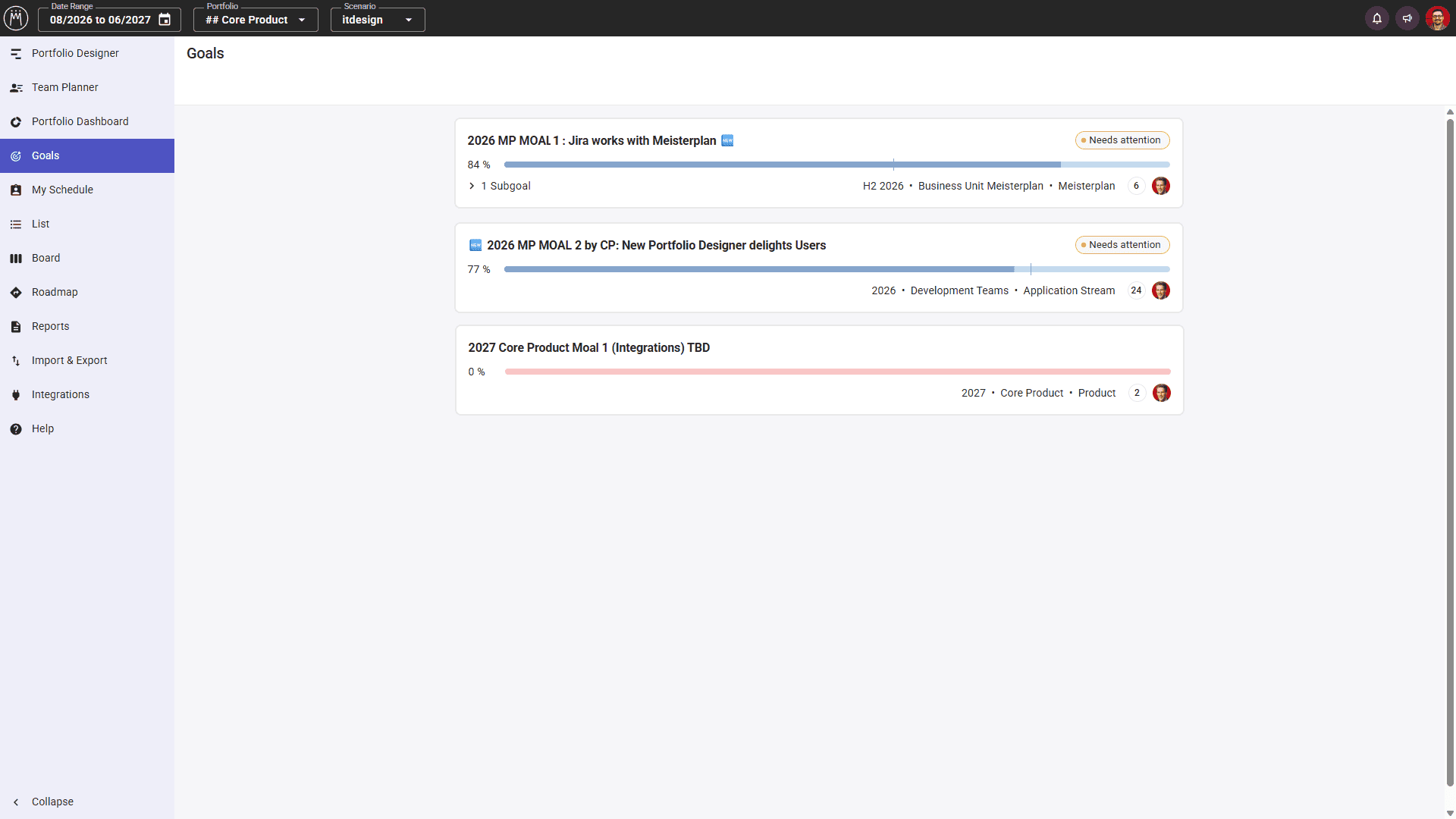
The company’s strategy, expressed through these goals, can be found in the Goals view, along with all the projects assigned to each goal.
Of course, simply documenting goals isn’t enough. We also need to make sure that projectsProjectA project is a time-limited undertaking with defined objectives and resources that delivers unique results and often includes complex tasks. contribute to them, starting from the moment a project idea first comes up for discussion.
“Onward, Ever Onward”: From Idea to Project Portfolio
This motto of Oliver Kahn, the former goalkeeper of Germany’s national soccer team, is what we also apply to our software development. Progress requires new ideas, and these ideas are discussed in the Project Pipeline Meeting, which takes place every 12 weeks. Participants include:
- Head of Product
- Head of Development
- Head of User Experience (UX)
- Portfolio and Product Management
- The respective Product Owners
The ideas discussed here come from a variety of sources. Some features, which are brought forward by the Product Owners, originate directly from customer feedback in Productboard or through our Customer Success colleagues. Strategic or specific observations from the Head of Product can also become projectProjectA project is a time-limited undertaking with defined objectives and resources that delivers unique results and often includes complex tasks. ideas.

What Susanne loves about Meisterplan
Capacity planning with Jira alone is almost impossible, especially since absences and vacations aren’t accounted for. Meisterplan incorporates this information and also provides an overview of long-term planning and priorities.
New initiatives need to demonstrate either that they align with current goals, or that there are good reasons to pursue them even if they don’t directly support one of those goals. The Project Scope helps with this assessment by providing information such as the project’s intended outcome and a very rough estimate of the expected effort.
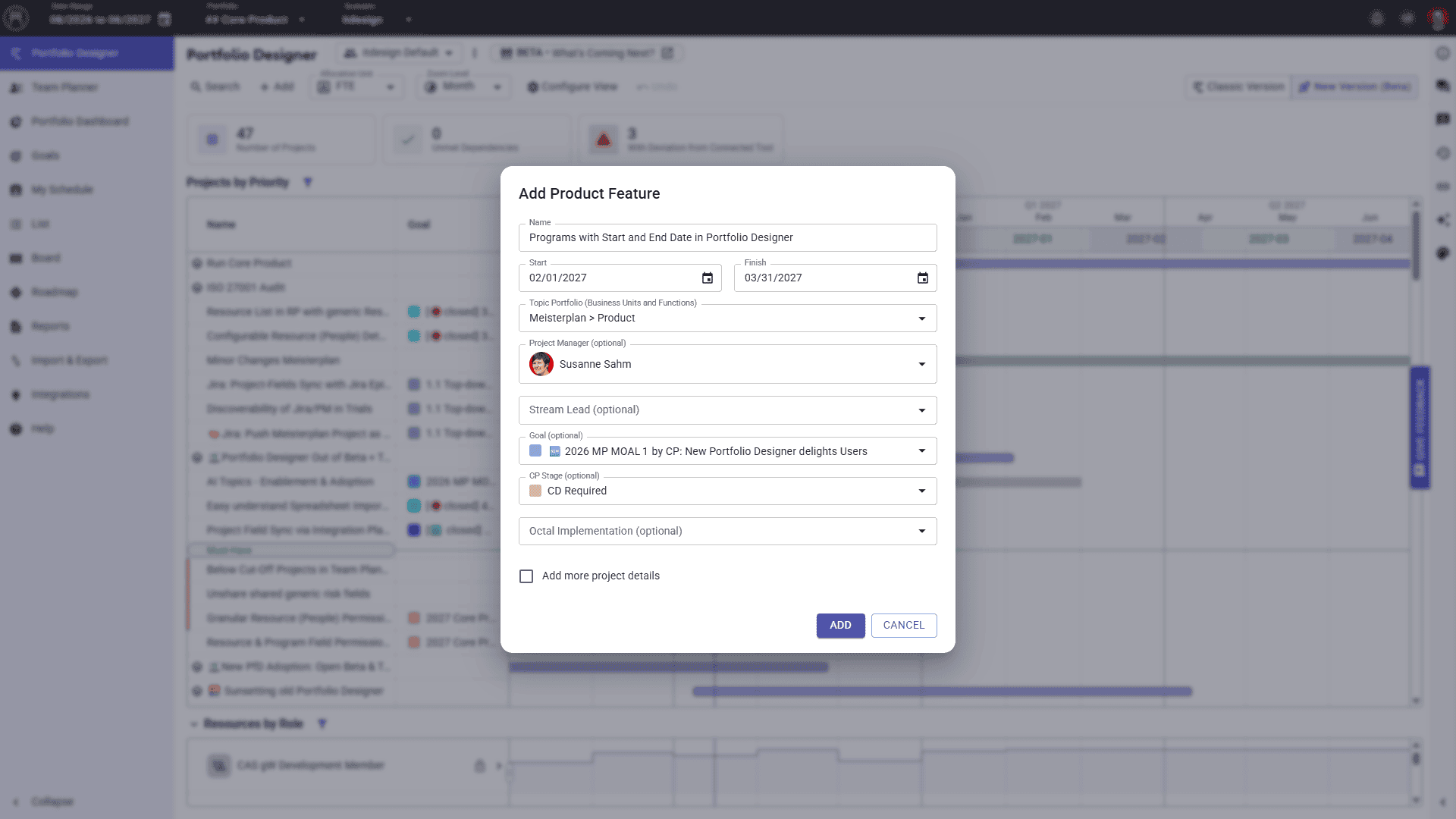
When new project ideas are created, we add all the details necessary at this early stage.
If an initiative clears this hurdle, it is initially scheduled roughly at a high level in the Portfolio Designer and appears in Meisterplan as a project for the first time. Who exactly will work on the project isn’t relevant yet because, when planning with Meisterplan, different time horizons require different levels of detail.
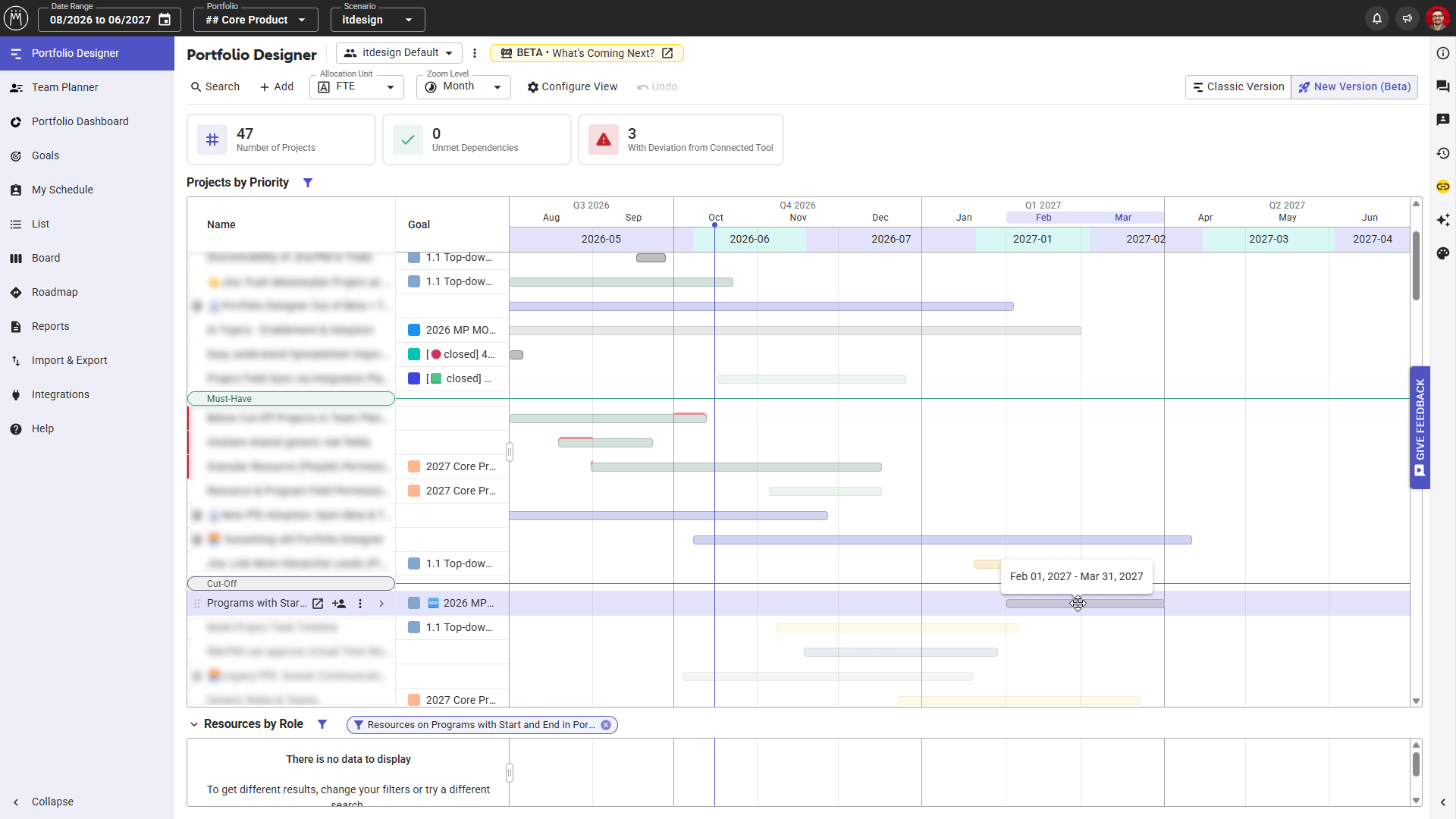
New projects that aren’t yet ready for execution remain below the cut-off line.
From Challenge to Solution: Evaluating and Prioritizing Project Ideas
The meeting where we decide whether to continue pursuing ideas or stop them is called the Portfolio Board Meeting, also known as Octal Planning, which refers to the fact that the meeting happens every six weeks. The same participants are involved as in the ProjectProjectA project is a time-limited undertaking with defined objectives and resources that delivers unique results and often includes complex tasks. Pipeline Meeting.
In this meeting, project ideas have to clear two hurdles, depending on their current stage, or Stage Gate. First, we assess whether the problem being addressed is a genuine business problem using a Challenge Description. If so, a proposed solution, the Solution Pitch, is developed before the next meeting. The Portfolio Board has to accept the Solution Pitch before implementation can begin.
A major benefit for the company is that projects can be stopped as early as the Shape phase, according to our Lean PPM framework. Meisterplan makes it much easier to estimate the value a project is likely to deliver and identify which projects will create the most value. That’s a significant change from the past, when starting a new project generally meant it would also be developed.

What Stefan loves about Meisterplan
We used to say that once we had a project, it would always be developed. Thanks to Meisterplan and the decision-making processes we use, projects are now sometimes rejected. This results in us successfully completing about 95% of our projects.
Another advantage of this is that the roadmapRoadmapA roadmap is a strategic overview of one or more projects, their progress, milestones, and objectives. communicated by Product Management is significantly more reliable.
I Need More Details: Planning Projects and Resources in Detail
As the projectProjectA project is a time-limited undertaking with defined objectives and resources that delivers unique results and often includes complex tasks. idea takes shape, we continue enriching the project information in Meisterplan. The project itself is initially planned roughly at the role level so that we can estimate how much capacity will be needed for execution. Once it’s clear which team is responsible for implementation, the role can be assigned to that specific team.
We also record information such as the project’s current Stage Gate, the project manager, and the current status. In addition to the project outcome summary, more detailed information is linked directly from the project to the corresponding Confluence page.
At Meisterplan, individual teams use Confluence to develop concepts and consolidate information. This follows one of our own principles: Teams should be able to work with the tools they need to achieve the best possible result.
This is especially important when projects move into execution, where Meisterplan benefits from its Jira integrationIntegrationAn integration is a virtual interface that connects different software programs and enables automated data exchange between them. This allows for more efficient processes, better planning, and consistent information.. This comes into play as soon as a project has been approved for implementation.
Moving Projects into Execution: Meisterplan Meets Jira
When it comes to projectProjectA project is a time-limited undertaking with defined objectives and resources that delivers unique results and often includes complex tasks. execution, Meisterplan’s philosophy is that teams should work in the way that suits them best. For us, that means projects planned in Meisterplan are executed in Jira in two-week sprints.
As at many software companies, the teams work with epics and stories. Product Owners plan what will be delivered by which team and with how much effort during the upcoming two-week sprint. Progress and budget are monitored here as well. As is typical in agile environments, the Scrum Master is responsible for ensuring that the projects are running smoothly and, if not, for identifying what is causing problems.
Linking Jira epics to the corresponding projects in Meisterplan through the integrationIntegrationAn integration is a virtual interface that connects different software programs and enables automated data exchange between them. This allows for more efficient processes, better planning, and consistent information. gives the Scrum Master several advantages. In Meisterplan, they can see how closely the team’s planned capacities in Jira align with the plans in Meisterplan – even across projects. Individual tasks, their timing, and dependencies can be clearly displayed directly in Meisterplan, and if needed, it takes just one click to jump directly to the project in Jira.
If potential bottlenecks are identified, these can be easily addressed via comments in Meisterplan. The solution remains as flexible as agile work requires. For example, effort data from Jira can be easily transferred to the Meisterplan plan with a click. Project scope can also be adjusted, with those changes then reflected both in the teams’ actual work and in Meisterplan.
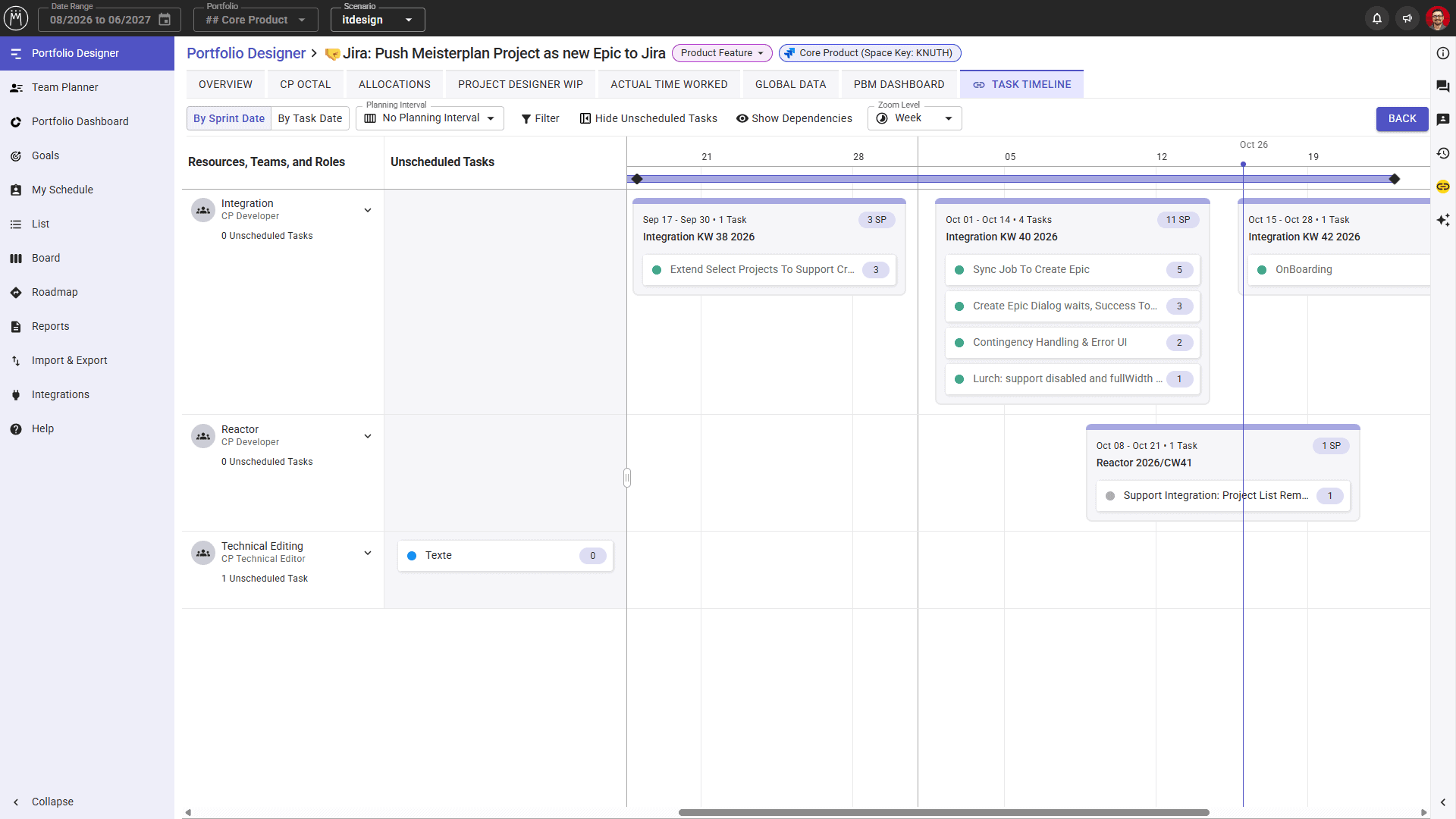
The Task Timeline in the Project Details view allows you to display specific Jira stories chronologically, organized by sprint.
So, How’s It Going? Keeping an Eye on Active Projects
Every six weeks, we take a broader look at the portfolio in the Portfolio Board Meeting mentioned earlier. This meeting isn’t just about moving new initiativesInitiativesSynonym for → ProjectA project is a time-limited undertaking with defined objectives and resources that delivers unique results and often includes complex tasks. forward. We also review how current projects are progressing.
Meisterplan’s Board view helps with both. It provides a clear overview and makes it easy to open the details of individual projects. Ideally, a green status indicates that everything is running smoothly. If there are issues that the Scrum Master hasn’t been able to resolve during ongoing implementation, the Portfolio Board meeting is where we try to find a solution.
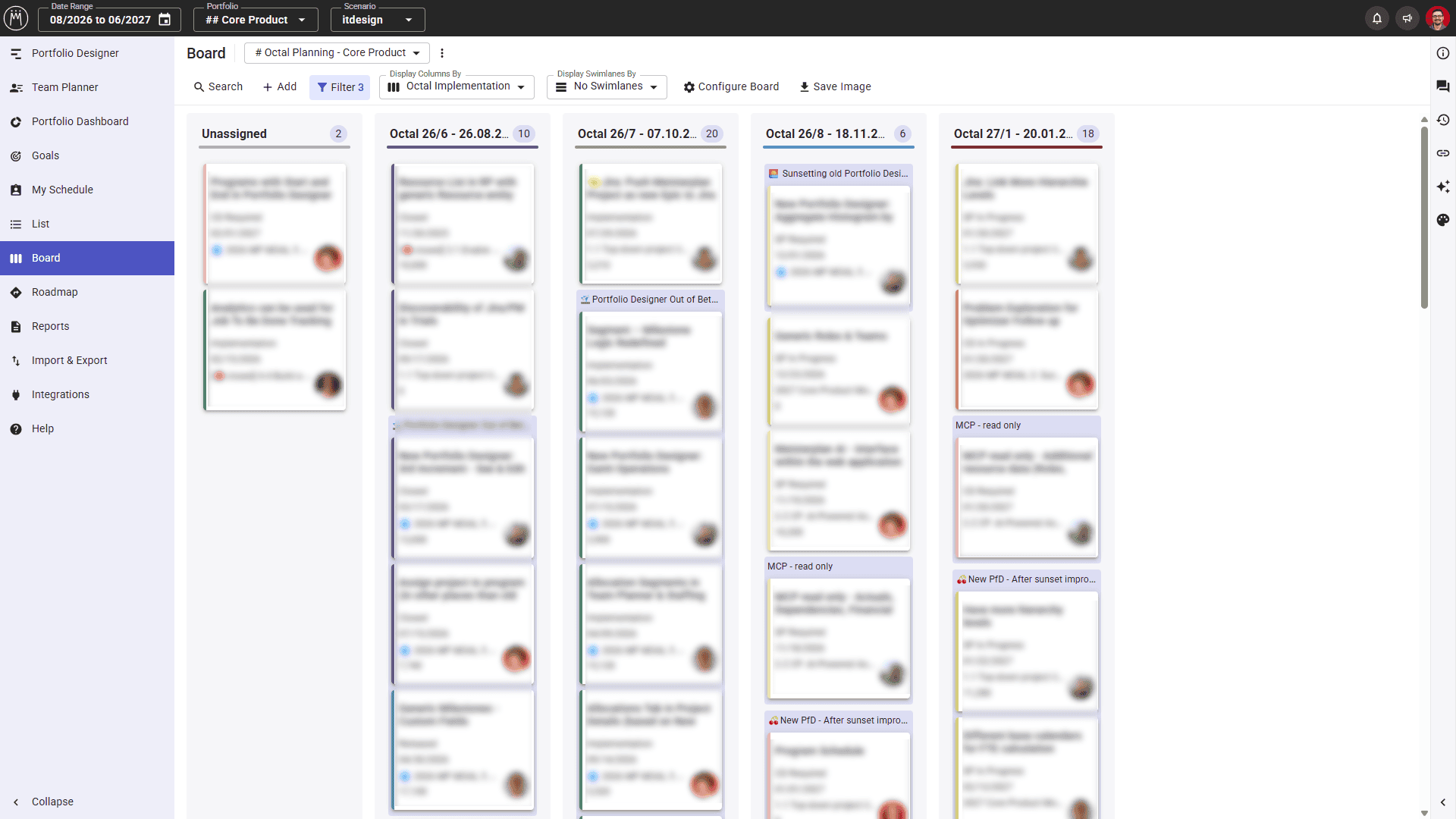
In the Board view, projects can be displayed in a customized Kanban board. Here, you can see them organized by octal.
When it comes to prioritizing and determining the timing of projects, the Portfolio Designer provides the necessary overview. It’s also important to continually revisit goals and assess how much each project contributes to them. Meisterplan’s Investments by Goal report provides the Portfolio Manager with this insight directly in Meisterplan.
Successful work doesn’t just depend on planning, however. Everyone also needs a transparent view of the plan, from executive leadership to individual team members. The clearest overview comes from the Meisterplan Roadmap, which lets everyone see which projects are currently underway and which are planned for the future.

What Joachim loves about Meisterplan
For me, Meisterplan is primarily about making problems visible. I benefit from being able to see the differences between the original plan and the current estimates in the tasks at a glance, directly from within Meisterplan via the Jira integration.
How Product Management Reviews Project Status Every Week
When you work agile, six weeks can be a rather long time. That’s why Meisterplan holds a Product Management Weekly which, as the name suggests, takes place every week.
Here, we review status updates for individual active projectsProjectA project is a time-limited undertaking with defined objectives and resources that delivers unique results and often includes complex tasks. and work to resolve conflicts.
But we also look at completed projects, such as after the release of a major feature. For this reason, the Head of UX and representatives from Technical Editing, our Meisterplan documentation team, are present at this meeting. They bring analyses from both the actual use of the software’s functions and the use of the Help Center to the meeting.
However, measuring the success of a project or feature is about more than just the immediate project success. The insights gained can also be valuable for future projects, so we evaluate them separately in Meisterplan.
After One Project Comes the Next: Measuring Success After Release
Once a feature has been released, the projectProjectA project is a time-limited undertaking with defined objectives and resources that delivers unique results and often includes complex tasks. in Jira (the story or epic itself) is complete. However, it remains open for review at the portfolio level in Meisterplan.
This review takes place in the 12 Weeks Analytics Meeting. In addition to the teams involved in developing the feature, anyone interested in whether and how a project or feature was successful can participate.
Various KPIs are considered. One straightforward indicator, for example, is the number of active users for a feature. After all, a feature that no one uses probably shouldn’t have been developed in the first place.
Ultimately, the goal is to determine whether the investment paid off or whether adjustments are needed, potentially including further enhancements to the feature.
Even the best planning can’t always prevent developed features from being less successful than expected. And that’s exactly why analyzing the results is so important: to reduce the chances of that happening again in the future.
Agile into the Future: Connecting Strategic Planning and Agile Execution
Calling Meisterplan a perpetual motion machine for Meisterplan itself might be a bit of an exaggeration, but it certainly has many advantages.
Every product improvement is an improvement for the product development of Meisterplan itself. Meisterplan customers benefit from the fact that the software isn’t developed in a vacuum. We use the product ourselves, which means it constantly has to prove its value in real-world practice.
Finally, the straightforward Jira integrationIntegrationAn integration is a virtual interface that connects different software programs and enables automated data exchange between them. This allows for more efficient processes, better planning, and consistent information. allows agile execution to stay aligned with resource planning across teams. The result is a successful product that can continue to evolve dynamically, even as strategic goals change.

What Johannes loves about Meisterplan
Meisterplan helps me set realistic goals because we can easily simulate what would actually be achievable with our teams over the next six months.
Meisterplan Planning and Steering Meetings
Goal Meeting
- Frequency: Every 6 months
- Participants: Head of Product, Product Owners, Portfolio Management
- Purpose: Documenting goals in Meisterplan
Project Pipeline Meeting
- Frequency: Approximately every 12 weeks
- Participants: Head of Product, Head of Development, Head of UX, Portfolio Management/Product Management, Product Owners (= Project Managers)
- Purpose: Determining whether initiativesInitiativesSynonym for → ProjectA project is a time-limited undertaking with defined objectives and resources that delivers unique results and often includes complex tasks. align with current goals; high-level planning of when topics will be addressed; identifying topics outside of current goals that are still worth pursuing.
Portfolio Board Meeting (Octal Planning)
- Frequency: Every 6 weeks
- Participants: Head of Product, Head of Development, Head of UX, Portfolio Management/Product Management, Product Owners (= Project Managers)
- Purpose: Reviewing the pipeline of topics to be implemented next; planning the next six weeks; determining whether the business problem is appropriate (Gate 1) and whether there is an accepted proposed solution (Gate 2)
Sprint Planning
- Frequency: Sprints (every 2 weeks)
- Participants: Product Owners, Scrum Masters, Teams
- Purpose: Detailed planning, execution, and progress and budget steering
Portfolio Board Meeting (Octal Planning)
- Frequency: Octals (every 6 weeks)
- Participants: Head of Product, Portfolio Management, possibly Product Owners and Project Managers
- Purpose: Planning of topics that are active or ready to be launched; determining whether the topic was delivered with the appropriate scope (Gate 3: Released)
Product Management-Weekly
- Frequency: Weekly
- Participants: Head of Product, Product Management, Product Owners, Head of UX, Technical Editing
- Purpose: Status updates from the Deliver phase, conflict resolution, and 1-month analytics for important releases
12 Weeks Analytics-Meeting
- Frequency: Every 12 weeks
- Participants: Product Team and anyone at Meisterplan who is interested
- Purpose: Reviewing ongoing health metrics, such as active users, and success KPIs for releases
FAQ
Meisterplan plans projectsProjectA project is a time-limited undertaking with defined objectives and resources that delivers unique results and often includes complex tasks., priorities, and team capacities at the portfolio level in Meisterplan. Development teams manage their day-to-day execution in Jira. The Jira integrationIntegrationAn integration is a virtual interface that connects different software programs and enables automated data exchange between them. This allows for more efficient processes, better planning, and consistent information. connects both planning levels and highlights deviations between portfolio and sprint planning.
Lean PPMLean PPMSynonym for → Lean Project Portfolio ManagementLean Project Portfolio Management (Lean PPM) is a lightweight framework for managing an organization’s project portfolio. It helps determine which projects to run, when to run them, and with which… structures recurring decisions throughout the process, from setting strategic goals and evaluating and prioritizing new initiatives to execution and measuring success.
Jira supports day-to-day planning and execution in development teams. For cross-project prioritization, long-term capacity planningCapacity PlanningCapacity planning and management refers to the process of matching the “capacity supply” (employees, resources, skills, etc.) with the “capacity demands” (projects) of an organization. It is considered a part…, and alignment with strategic goals, Meisterplan also uses its own portfolio and resource managementResource ManagementWhen it comes to resource management, the focus is on the optimal planning, coordination and monitoring of resources. The term “resources” includes things like employees, budgets, materials and time. software.
A development project can be considered complete in Jira once it has been released, but it remains open at the portfolio level until the feature’s usage and success have been evaluated. Only then is a decision made about whether to close the project or continue it.
Read Next


Meisterplan Stands Out in the Vendor Selection Matrix™ 2025
Meisterplan is the leading Project Portfolio and Resource Management solution – ranked #1 in the independent Vendor Selection Matrix™ 2025 report. Users consistently praise its exceptional customer service and top-tier product quality.

Lean PPM
Through its cloud software and Lean PPM™, Meisterplan enables business leaders to drive decisions that keep their organizations moving forward. The Lean PPM™ framework consists of all the roles, tools and meetings your organization needs to develop and prioritize initiatives and quickly adapt your plans so your organization thrives even in times of constant change.