
Many companies cannot demonstrate the value of their portfolios using portfolio management KPIs. Instead, they treat portfolio management as a way to report on the status of individual projectsProjectA project is a time-limited undertaking with defined objectives and resources that delivers unique results and often includes complex tasks..
But this leaves a more important question unanswered: Are the projects collectively achieving what the company really needs?
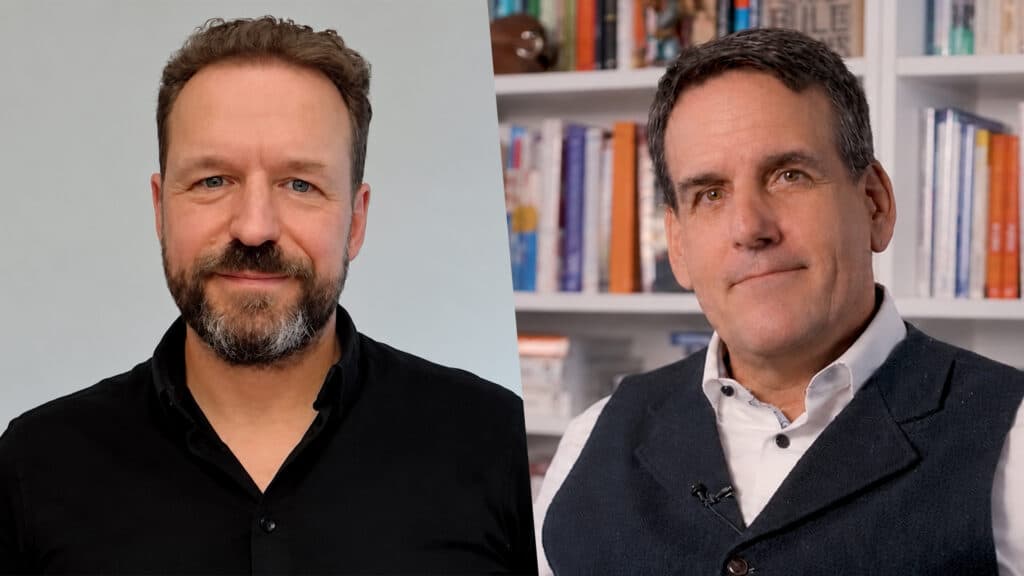
That’s exactly what Dr. Christoph Hirnle, Executive Director of Customer Engagement at Meisterplan, discusses with Mark Engelhardt in episode 57 of the PMPMSynonym for → Project ManagementProject management is the planning, steering, and monitoring of projects to achieve specific objectives within a given timeframe and budget. Cowboy Podcast. For me, there’s an important takeaway: Good portfolio management doesn’t start with the project status, but with the desired outcome. I’d like to share a few more insights I took away from this fascinating conversation.
How a Conversation About Portfolio Management Can Change Your Perspective
Some statements stick with you. In the podcast episode, Christoph shares that he simply can’t accept that people should have to spend such a large part of their lives in jobs where they’re overloaded, caught up in “political struggles,” and unable to do the work they’re actually there to do.
After that, I couldn’t stop thinking about this episode. The conversation lasts over two hours and yet it’s anything but dry.
Watch the PM Cowboy Podcast #57 with Dr. Christoph Hirnle on YouTube
Why Do So Many Portfolios Struggle to Demonstrate Their Value?
Because organizations launch projects without defining their goals.

Christoph often asks teams a simple question: What is the desired outcome of this project? Frequently, he gets no answer. And this doesn’t just apply to individual projectsProjectA project is a time-limited undertaking with defined objectives and resources that delivers unique results and often includes complex tasks., but often to entire portfolios.
He calls this the “Spice Girls Principle”: Tell me what you want, what you really, really want.
It sounds simple, but most people have never been trained to think this way. We learn how to manage projects and how to read reports. The why gets lost along the way.
Back in 1963, Peter Drucker wrote in Harvard Business Review that nothing is quite so useless as efficiently doing something that shouldn’t be done at all. According to Christoph, we’re still lacking a method for identifying the areas with the greatest potential and concentrating resourcesResourceResources are all the people, places and things that you need to complete projects. The most important resource? Employees, of course! where they’ll have the most impact.
What’s the Difference Between Portfolio Management from Project Reporting?
Project reporting shows how individual projects are performing. Portfolio management shows whether those projects are collectively achieving what the company needs. Christoph explains that project portfolio managementProject Portfolio ManagementProject portfolio management (PPM) is a process that seeks to select, prioritize, monitor and analyze a company’s projects. is often viewed and designed primarily as a way to report on individual projectsProjectA project is a time-limited undertaking with defined objectives and resources that delivers unique results and often includes complex tasks..
Here’s a comparison:
| Project Reporting | Value-Driven Portfolio Management | |
| Key question | How far along is each project? | What outcome should the portfolio achieve? |
| Focus | Individual projects | Sponsors’ objectives and business KPIs |
| Result | Traffic-light status indicators | Decisions about who works on what |
| Leadership’s Role | Ask for details | Understand the consequences of decisions |
The questions to ask are simple:
- What is the portfolio intended to achieve, and what business problem should it solve?
- What do our sponsors want to achieve, and what criteria will they use to measure their success?
- How does management know that we’re making progress?
If the portfolio’s objectives don’t align with these answers, it’s difficult to demonstrate its value.
What’s the Difference Between Portfolio Management from Project Reporting?
Project reporting shows how individual projects are performing. Portfolio management shows whether those projects are collectively achieving what the company needs. Christoph explains that project portfolio managementProject Portfolio ManagementProject portfolio management (PPM) is a process that seeks to select, prioritize, monitor and analyze a company’s projects. is often viewed and designed primarily as a way to report on individual projectsProjectA project is a time-limited undertaking with defined objectives and resources that delivers unique results and often includes complex tasks..
Here’s a comparison:
Project Reporting
- Key question: How far along is each project?
- Focus: Individual projects
- Result: Traffic-light status indicators
- Leadership’s Role: Ask for details
Value-Driven Portfolio Management
- Key question: What outcome should the portfolio achieve?
- Focus: Sponsor’s objectives and business KPIs
- Result: Decisions about who works on what
- Leadership’s Role: Understand the consequences of decisions
The questions to ask are simple:
- What is the portfolio intended to achieve, and what business problem should it solve?
- What do our sponsors want to achieve, and what criteria will they use to measure their success?
- How does management know that we’re making progress?
If the portfolio’s objectives don’t align with these answers, it’s difficult to demonstrate its value.
Why Do Leaders Become Micromanagers?
Because they’re only shown project details, not the impact of their decisions. When a manager asks about a delayed milestoneMilestoneIn project portfolio management, a milestone marks an important point in a project’s progress that requires monitoring or decision-making. Milestones indicate project phases, marking the completion of objectives or the… in a meeting, it isn’t necessarily because they’re obsessed with control. It’s simply the only information they’ve been given.

Christoph and Mark approach this topic with surprising empathy. They don’t see leaders as control freaks, but as people who face high expectations without always having the right conditions in place to meet them.
As a result, they approve one projectProjectA project is a time-limited undertaking with defined objectives and resources that delivers unique results and often includes complex tasks. after another, because nobody shows them what those decisions mean for resourceResourceResources are all the people, places and things that you need to complete projects. The most important resource? Employees, of course! capacity.
A study by Harvard Business Review Analytic Services, conducted as part of the PMI Brightline Initiative, supports this. Around 100 executives worldwide cited too many simultaneous initiatives, poor communication, and poorly managed resources as the biggest obstacles to strategy execution. A lack of project managementProject ManagementProject management is the planning, steering, and monitoring of projects to achieve specific objectives within a given timeframe and budget. skills only came in eighth place. The leaders weren’t pointing fingers at their teams; they were pointing at themselves.
Another training course for project teams won’t solve a problem that’s rooted in the system.
How Do I Answer the Portfolio KPI Question in Practice?
Start with your leadership’s objectives, not the projects. Christoph begins by asking executives what they need to achieve this year. For a CIO, the answer might sound something like: spend no more money than last year, avoid any security vulnerabilities, and show the board that the company is making progress on AI. Then he asks how portfolio management can help achieve those exact goals.
His rule of thumb for priorities: Ask your boss what’s important to them. That’s your strategy. Then ask which KPIs are important to them. That’s your portfolio KPI.
His Lean PPM framework supports this process with four decisions:
- Set the Framework (Strategize): What should this portfolio achieve in the next planning period, and what resourcesResourceResources are all the people, places and things that you need to complete projects. The most important resource? Employees, of course! will we make available?
- Build the Pipeline (Collect): Is an initiativeInitiativeSynonym for → ProjectA project is a time-limited undertaking with defined objectives and resources that delivers unique results and often includes complex tasks. relevant enough to warrant further attention right now?
- Allocate Resources (Design): Which initiatives receive which capacities, and when?
- Optimize Locally (Execute): How can we make the best possible use of the capacity we’ve committed?
These decisions don’t happen one after another. They happen simultaneously, like a performer who keeps multiple plates spinning.
Prioritization isn’t an algorithm, but a process in which different parts of the organization contribute information. A prioritized project list on a slide is just a wish list, because every portfolio is constrained by its available resources.
Who Should Make Portfolio Decisions?
The people closest to the problem. Christoph applies the KanbanKanbanKanban is a method that uses cards on boards (called Kanban boards) to display and organize work or decision-making processes. Tasks or projects are noted down on cards and moved… principle to portfolios: The person working on the production line decides when more supplies are needed. If two projectsProjectA project is a time-limited undertaking with defined objectives and resources that delivers unique results and often includes complex tasks. are competing for the same person, the project managers work it out between themselves instead of escalating the issue to the portfolio board.
One of his clients, an organization with 15,000 employeesEmployeesSynonym for → ResourceResources are all the people, places and things that you need to complete projects. The most important resource? Employees, of course! across 50 countries, manages 38 portfolios. The executive board focuses solely on its own ten projects. Everything else is decided where the expertise resides, with each portfolio following its own cadence and processes.
This kind of trust changes an organization’s culture. It’s the opposite of “submarine projects” that operate under the radar because no capacity has been officially allocated to them.
Where Do I Begin?
Start with a small island rather than the entire organization. Find one team where everyone knows something isn’t working: they’re either overloaded or failing to deliver despite significant investment. Start by creating transparency there. Christoph says these people will beg you to keep going.
A real-world example from a retail company: A German retail company had around 200 people in a central technology unit that served several brands. Every brand felt it was being treated unfairly, strategic objectives weren’t being met, and the team was at risk of burnout. After introducing Lean PPMLean PPMSynonym for → Lean Project Portfolio ManagementLean Project Portfolio Management (Lean PPM) is a lightweight framework for managing an organization’s project portfolio. It helps determine which projects to run, when to run them, and with which…, the brands now understand why decisions are made. Priorities are clear, and teams can focus on the work they’re actually there to do.
And what about the software? Even a sheet of paper, an Excel spreadsheet, or an email is a form of information technology. The first step can be as simple as making a list: What have we committed to, and by when? Many companies have struggled with cumbersome all-in-one solutions that created more administrative work than they were worth. For every piece of information, ask yourself: What decision am I trying to make with this?

How Does a PMO Demonstrate Its Value?
By making the improvements resulting from its work visible. Sponsors change, and the successor often doesn’t know what a PMOPMOSynonym for → Project Management OfficeA Project Management Office (PMO) is a permanent organizational unit responsible for the centralized and coordinated management of all projects. actually does. Christoph’s answer to this is the Value Realization phase from the PMO value concept: Choose a KPI, measure the baseline, and show what has changed after one cycle. Then hand that slide to the next person.
Why Is This Podcast Episode Worth Listening To?
Because it shows two people who critically examine their own field without ever losing sight of the human element. That’s what makes the episode so special. It speaks to executives, PMOPMOSynonym for → Project Management OfficeA Project Management Office (PMO) is a permanent organizational unit responsible for the centralized and coordinated management of all projects. leaders, project managers, and everyone else working between strategy and execution in an organization.
Portfolio management isn’t an end in itself. It’s a means of ensuring that the right people can work on the right things at the right time, without burning out in the process.
Take the time to listen. Maybe in two sessions, or perhaps while you’re out for a walk.
Read Next

What If Our Plans Actually Worked?
Wouldn't it be awesome if our plans actually worked? To make this happen, we need a portfolio management method that is easy to understand, learn, and maintain. Let's work together to make this a reality.
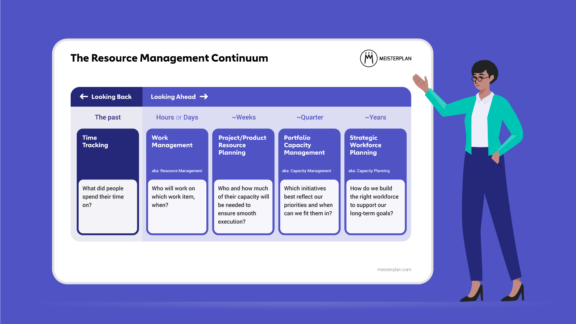
Resource Management Doesn’t Have to Be Rocket Science. Try Our Simple Approach.
It's no secret that it’s hard to manage multiple projects at the same time. The Resource Management Continuum is a simple and straightforward approach to make sure you stay organized.