

The search for the “one-truth-to-rule-them-all” in your company’s data can often feel like a Herculean taskTaskSynonym for → ProjectA project is a time-limited undertaking with defined objectives and resources that delivers unique results and often includes complex tasks.. People have been teetering between the desire for total control over tools and maximal freedom for your teams for over 20 years now. In the current day and age of 2026, we have some good news: A Single Source of Truth is absolutely achievable. You just need clever data architecture. This article shows why the solution lies neither in a monolithic “all-in-one suite”, nor in “best of breed” chaos, but instead in intelligent integrationIntegrationAn integration is a virtual interface that connects different software programs and enables automated data exchange between them. This allows for more efficient processes, better planning, and consistent information..
A Look to the Past: When ERP Promised Everything
The 2000s: Monoliths and Shadow ITs
The early 2000s was the era of IT Monoliths. Think SAP, Oracle, and others like them, who promised one ERP system for everything. Supervision over everything and a Single Source of Truth. They were extensive, but not made for everyone, and teams became frustrated.
As a result, employeesEmployeesSynonym for → ResourceResources are all the people, places and things that you need to complete projects. The most important resource? Employees, of course! came up with their own solution: Shadow IT was born. The “official” Single Source of Truth now merely existed on paper, but the truth lived in Excel tables.
From 2010 On: The Big SaaS Party
Then, thanks to cloud technologies which made specialized software (without their own infrastructure) available to everyone, teams were able to have more flexibility. Under the motto “Best of Breed”, every team had their own specialized tool – like HubSpot for marketing or Jira for development. Needed to connect them? No problem! APIs promised unlimited options for integrationsIntegrationAn integration is a virtual interface that connects different software programs and enables automated data exchange between them. This allows for more efficient processes, better planning, and consistent information..
The downside only became apparent years later: What drove productivity in teams was also responsible for exploding SaaS costs, and massive coordination problems (otherwise known as the Saas Sprawl).
2026: The Renewed Desire for Consolidation
Now, it looks like this party has come to an end, and the resulting pains are enormous. The wish for more order is big, but be careful! The answer is not to be found by returning to the monoliths of the past. Instead, it can be found in an integrations architecture that sees autonomy as a prerequisite for a strategic overview, not as an obstacle.
But before we sketch out the solution, we have to understand a few things: Why is specialization so important? When does freedom turn into anarchy? And why does the SaaS suite fail as a supposed savior?

Why Best of Breed was the Right Choice
The triumph of specialized software was no accident. It was the answer to a work environment that had become too complex for universal standard suites. Those who oppose tool diversity today often stand in the way of their own adaptability. Here are three reasons why you should keep your teams’ specialized tools.
When the Tool Fits the Mode of Thinking
Remember, a hammer is perfect for a nail but useless for a screw! For instance, consider a team of developers. What they don’t need is general “taskTaskSynonym for → ProjectA project is a time-limited undertaking with defined objectives and resources that delivers unique results and often includes complex tasks. administration”. Instead, they make use of workflows for sprints, backlogs, and automated code reviews.
If you force agile teams to work in the project module of a financial suite, efficiency drops demonstrably. Resistance from the team will grow, and data maintenance will become a burden. We know, though, that “let teams work the way the want“ is not only a marketing phrase – it’s also a tool to turn the tides.
Background Theory:
The Task Technology Fit model (Goodhue & Thompson, 1995) shows that IT only increases performance when the technology’s functionality fits precisely with the tasks at hand.
Learn more here: Task-Technology Fit Model
Adaptability Through Local Flexibility
A definitive plus for specialized tools is the speed with which an organization can utilize new knowledge. A specialized tool can often be introduced seamlessly because it builds on existing skills. These decentralized adjustments don’t need a company-wide transition, and don’t overwhelm employeesEmployeesSynonym for → ResourceResources are all the people, places and things that you need to complete projects. The most important resource? Employees, of course!.
The strategic advantage is that a modular landscape allows you to test new methods in the relevant niches. You can pilot test optimizations, and then introduce them to more departments if they lead to success. Or you can disregard less successful tests without disrupting the entire tool landscape. This agility is exactly what monoliths do not allow with their rigid structure.
Background Theory:
The concept of Absorptive Capacity was defined by Cohen & Levinthal (1990) as a firm’s “ability to recognize the value of new information, assimilate it, and apply it to commercial ends.”
Learn more: Adaptive Capacity
The Importance of Autonomy
Why do teams defend their tools so passionately? Because people are the most engaged when their basic needs for autonomy are fulfilled. When teams can select their methods and tools themselves, they exercise autonomy and take responsibility – a known driver of data quality.
Coercion, on the other hand, forces people to work by the book. Systems are available, but they are empty in terms of content.
Background Theory:
Self-Determination Theory (Deci & Ryan) proves that autonomy, competence, and social connectedness promote engagement.
Learn more: Self-Determination Theory
The Problem:
Although these arguments are convincing, they only explain why specialization is important, not how you can use it to solve existing coordination problems. Here is where the dilemma starts.

How Anarchy Can Overtake Agility
Problem 1: SaaS-Sprawl
What began as freedom has devolved into hundreds of subscriptions. 53% of SaaS licenses are unused – quite a significant cost factor. This leads to an immense administrative effort from the IT and Procurement departments – from managing licenses, controlling who has access to what, and performing security audits. This administrative headache eats away at the time that specialized tools should be able to save.
Problem 2: Toggle Tax
The human brain isn’t perfectly designed for multi-tasking. Each switch between tools – whether it be from Slack to Jira, or from Excel to Salesforce – takes focus and can add to your mental clutter, which can make concentrated work more difficult. As a result, employees spend 9% of their time switching between apps instead of delivering value.
Background Theory:
Our brains can only comprehend a certain amount of information at a given time. Changing contexts can overburden this ability.
Learn more here: Cognitive Load Theory
Problem 3: Spaghetti Architecture
The technical backbone of many organizations nowadays is a type of “Spaghetti Architecture”. In order to connect disparate solutions, point-to-point integrationsIntegrationAn integration is a virtual interface that connects different software programs and enables automated data exchange between them. This allows for more efficient processes, better planning, and consistent information. are often hastily built. The result is fragile; if a single tool changes its API, then connections may be broken but remain unnoticed. Information that gets changed in one location, will either be delivered with errors, or not at all, to the rest of the organization.
This unreliability leads to an “integration tax” — an extra expense that forces IT teams to spend more time preparing unstable bridges than actually driving innovation forward.
In Summary:
Best of Breed alone is not the solution. So, should you turn back to the suite?

Why Returning to a Data Monolith Can be Dangerous
Given this chaos, the promise of a single system, with a single data model and no integrationsIntegrationAn integration is a virtual interface that connects different software programs and enables automated data exchange between them. This allows for more efficient processes, better planning, and consistent information. needed, can sound enticing. For Procurement and IT, the suite-model offers tangible benefits, like massive discounts, a contract partner, and minimal administrative effort.
However, this supposed calm can be misleading. Three problems can speak to the danger of the suite:
Shelfware & the Return of Shadow ITs
Unfortunately, a suite won’t lower costs either. A Gartner analyst found that 25-30% of features in Enterprise Suites remain unused. This means people pay for powerful packages, but only use bits and pieces, because the modules don’t fit for their real-world needs. This is not only less cost effective, but also leads to the return of shadow ITs.
The GIGO Spiral: Garbage In, Garbage Out
If teams are forced to use sub-optimal modules, they will be less and less accepted. Data won’t be carefully managed. The suite should deliver a Single Source of Truth – but instead it merely delivers junk.
Background Theory:
The Technology Acceptance Model demonstrates that users accept software when they see it as useful and simple. Large compromise suites often fail.
Learn more here: Technology Acceptance Model
Vendor Lock-In: Strategic Paralysis
Once the suite is deeply embedded in all of your process and departments, you’ll quickly become dependent on this particular suite; in other words, you’ll find yourself in a state of vendor lock-in.
Is your vendor missing out on trends? If so, you’ll miss out on them too. Does your vendor make it possible to integrate with other tools? You could be pigeon-holed into only using worse tools. Did your vendor raise its prices? You’ll stay, because data migration and onboarding your employeesEmployeesSynonym for → ResourceResources are all the people, places and things that you need to complete projects. The most important resource? Employees, of course!, among a host of other tasksTasksSynonym for → ProjectA project is a time-limited undertaking with defined objectives and resources that delivers unique results and often includes complex tasks., could cost you millions. The desired simplification of your admin can become a strategic obstacle – and with that, you’ll lose the ability to flexibly react to market trends.
Best of Breed vs. Enterprise Suite
Best-of-Breed | All-in-One Suite | |
|---|---|---|
| Accuracy of Fit | ✅ Excellent TaskTaskSynonym for → ProjectA project is a time-limited undertaking with defined objectives and resources that delivers unique results and often includes complex tasks./Technology Fit | ❌ Specialists have to compromise |
| Motivation | ✅ Autonomy supports motivation and personal responsibility | ❌ Coercion leads to working strictly by the book |
| Cost Efficiency | ❌ Too many licenses, with as many as 53% unused | ⚠️ Discounts when purchasing, but about 25-30% unused modules/functionality |
| Integration | ❌ Many silos and interfaces connected via a spaghetti architecture | ✅ One unified UX, including native integrationIntegrationAn integration is a virtual interface that connects different software programs and enables automated data exchange between them. This allows for more efficient processes, better planning, and consistent information. of all modules |
| Change Management / Ability to Innovate | ✅ Totally flexible, with no lock-in effect | ❌ High cost of change, dependent on one provider |
| Single Source of Truth | ⚠️ Locally, yes, but not across teams | ⚠️ On paper, yes, but not in reality |

The Way Out: “Managed Autonomy” Through “Hub & Spoke”
The good news: this third way already exists! It’s called “managed autonomy”, and it’s implemented via an intelligent Hub & Spoke integration. This architecture does what was previously thought of as impossible: preserving best of breed specialization while creating the strategic overview of the all-in-one suite.
Let Us Demonstrate: Consider an Airport
Imagine you’re at an airport. The specialized teams are the airplanes (in this case, the spokes). Every pilot gets their own prepared machine from the organization. They have the ability to steer however they want. They know what to do – after all, they are the experts.
The tower (hub) does not dictate how the pilots should fly. Instead, it coordinates when and where flights take place. It ensures that there are no collisions, that everyone arrives safely, and that the entire system functions properly.
Applied to your IT landscape: Teams continue to work in their specialized tools – Jira for development, HubSpot for marketing, Asana for project managementProject ManagementProject management is the planning, steering, and monitoring of projects to achieve specific objectives within a given timeframe and budget.. However, strategically relevant data automatically flows into a central hub that acts as an integration and coordination point.
How Hub & Spoke Compensates for the Disadvantages of a Best-of-Breed Landscape
Problem 1 Solved – SaaS-Sprawl:
A curated set of best-of-breed tools offers freedom within guidelines. IT retains governance; it decides which tools are integrated into the hub. The departments maintain their efficiency; they work with tools that suit their tasksTasksSynonym for → ProjectA project is a time-limited undertaking with defined objectives and resources that delivers unique results and often includes complex tasks.. This prevents uncontrolled growth without stifling innovation.
Problem 2 Solved – Toggle Tax:
Since the hub aggregates all information, a strategic overview is created in one place. Operational staff can stay productive using the specialized app that perfectly suits the task. Management no longer has to jump between twenty dashboards – they have all the information relevant to decision-making in the hub.
Problem 3 Solved – Spaghetti Architecture:
Instead of connecting each tool to every other tool, each application now only connects to the central hub. Complexity is dramatically reduced; instead of endless, fragile point-to-point connections, you only need stable hub connections. The data flow becomes stable, maintainable, and reliable.
The Essence of Managed Autonomy
Order at the center only works when there is freedom at the edges. It is the path to a Single Source of Truth based not on constraint, but on intelligent integrationIntegrationAn integration is a virtual interface that connects different software programs and enables automated data exchange between them. This allows for more efficient processes, better planning, and consistent information..
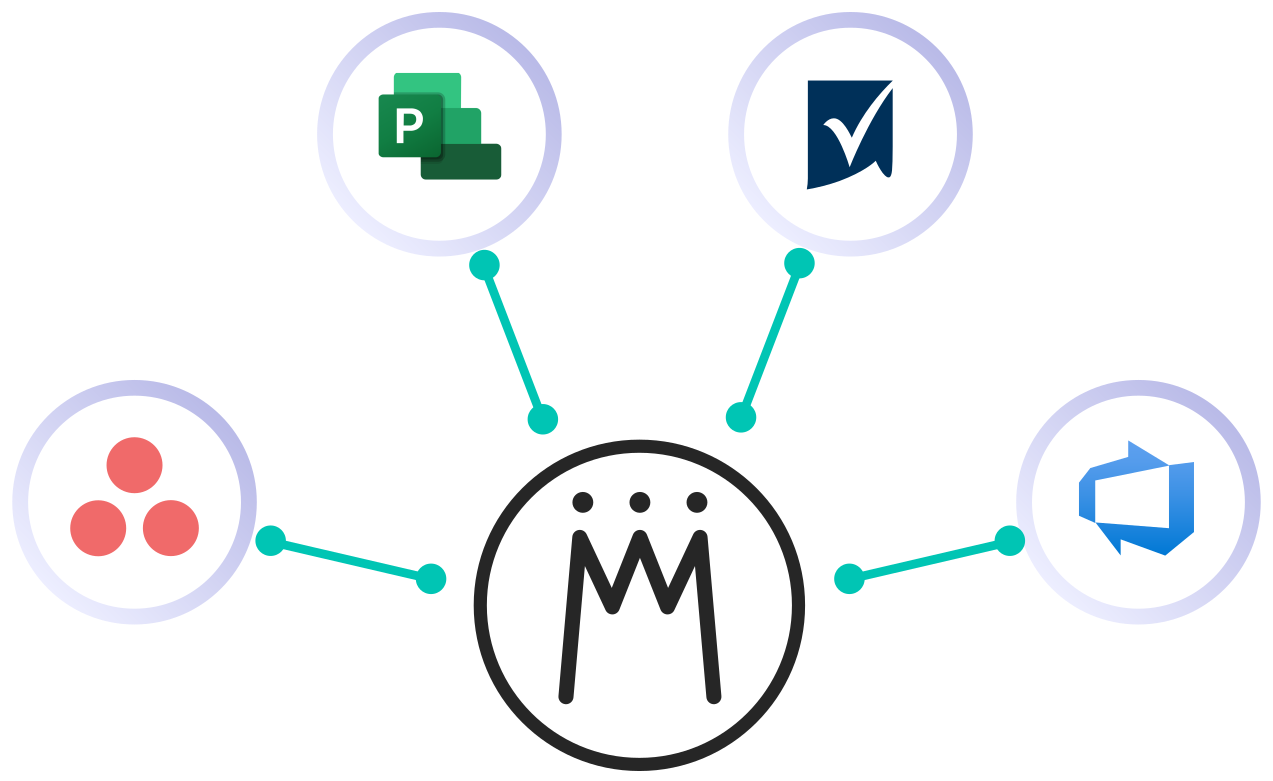
Meisterplan: The Strategic Integration Hub in Practice
Meisterplan implements this model in practice – as a strategic hub that strikes a balance between decentralized freedom and centralized control.
Selective integrations instead of copying data:
This solution does not lie in blindly integrating every piece of data. Meisterplan focuses on the essentials with a growing number of maintenance-free, out-of-the-box connections. Only the information that really matters for portfolio decisions flows into the hub. This creates a Single Source of Truth – not through sheer volume, but through strategic validity.
Automatic translation for both worlds:
Meisterplan automatically translates operational data into strategic language. Teams don’t have to interrupt their work for manual reporting. They stay productive in Jira or Azure DevOps, or whatever other tools they use. At the same time, decision-makers get the portfolio overview they need – without jumping between tools. The toggle tax disappears for both sides.
From decentralized expertise to strategic leverage:
Team autonomy becomes a strategic advantage. Meisterplan allows expertise at the edges and coordinates the results centrally. With portfolio visibility and intuitive scenario simulationScenario SimulationSynonym for → ScenarioIn project portfolio management (PPM), scenarios are potential ways that your portfolio can look, based on a set of well-defined assumptions and portfolio decisions. Scenario planning is used to forecast…, managers can make reliable commitments: When will projectsProjectA project is a time-limited undertaking with defined objectives and resources that delivers unique results and often includes complex tasks. really be finished? Which plans can be implemented with the available resourcesResourceResources are all the people, places and things that you need to complete projects. The most important resource? Employees, of course!?
Conclusion: Integration Makes a Single Source of Truth Achievable
The big question in 2026 isn’t “what software can do everything?”.
It’s “how do we coordinate specialists so that the whole is greater than the sum of its parts?”.
A Single Source of Truth is not unattainable. It was just never a single system – it is an integration architecture. Hub & Spoke is neither a return to the monolith nor a continuation of chaos. It is the intelligent integration of specialized tools into an orchestrated overall architecture.
Read Next


No One Wants to Use the New Tool? 3 Levers to Increase Software Adoption
We’ll show you why tool adoption is the key to effective use and data quality, why it often fails, and three simple ways to foster it in the long term.

How to Harness the Power of Your Team from Any Seat!
Just because a group of people come together to work, doesn't mean that they're a team. Read this insightful blog post from expert Sinikka Waugh to learn how to best establish a successful team dynamic.