

Recently, I spoke with a client about a struggle I’ve heard from others: how can a company adhering to an agile work methodology best implement company-wide initiativesInitiativesSynonym for → ProjectA project is a time-limited undertaking with defined objectives and resources that delivers unique results and often includes complex tasks. which affect the very fabric of its organization?
Something like implementation of GDPR (General Data Protection Regulation) policy influences the day-to-day of all levels and departments of a company, from sales to HR and controlling to marketing—no one is exempt. Still, how do project managers in an embedded agile environment implement these changes after having shifted to a client-focused structure free of centralized PMOs?
Trend: Projects to Products
With such widespread adoption of the agile working method, particularly in the IT sector, the focus is changing. A new trend is emerging worldwide: companies do not necessarily focus on organizing work in an agile fashion at the projectProjectA project is a time-limited undertaking with defined objectives and resources that delivers unique results and often includes complex tasks.-level, but rather on making the entire organization more agile.
The “old” model, where project managers fought over resourcesResourceResources are all the people, places and things that you need to complete projects. The most important resource? Employees, of course! and negotiated priorities, is growing antiquated. Instead, organizations are thinking long-term. Gone are the days of lengthy negotiations about individual projects, complaints about project delays, the painstaking process of assembling a team for each new project, thumb-twiddling until the right experts are available, and subsequent disputes over change requests.
The focus has shifted to “products” or “value streams” — long-term investments. Teams are now multidisciplinary entities working together regularly. In other words, they are cross-functional teams who can function with greater independence from other organizational units.
I won’t go into more details about these approaches in this post, though other approaches such as on SAFe, Large-Scale Scrum (LeSS), Nexus or Flight Level (FLM) do make for good reading. Still, there are many opposing viewpoints on these approaches, even within the agile community, interestingly even amongst the authors of the original Agile Manifesto.
Products No Longer Require Resource Management
What I’m concerned with is the question of whether you still need resource management when your teams are fixed and permanent. With a team comprised of subject matter experts, technical specialists, and managers working together regularly, the traditional issues of resource managementResource ManagementWhen it comes to resource management, the focus is on the optimal planning, coordination and monitoring of resources. The term “resources” includes things like employees, budgets, materials and time. are reversed: projectsProjectA project is a time-limited undertaking with defined objectives and resources that delivers unique results and often includes complex tasks. no longer wait for resourcesResourceResources are all the people, places and things that you need to complete projects. The most important resource? Employees, of course!, now resources wait for projects. Teams work through a topic to pull the next one from the prioritized backlog.
Interestingly, our customers no longer speak of “projects,” but rather “business epics,” “features,” “insurance products,” or “customer offerings” — precisely the terms that internal departments have always used.
To summarize these developments:
- Rise of dedicated teams
- Technical and subject matter experts work together directly
- Prioritized backlog instead of project portfolio managementProject Portfolio ManagementProject portfolio management (PPM) is a process that seeks to select, prioritize, monitor and analyze a company’s projects.
- Multi-level prioritization (at the bottom for the sprint, from above for the product, from above for a program or release train, etc.)

So Long Resource Management… or?
And so, we close the book on resource managementResource ManagementWhen it comes to resource management, the focus is on the optimal planning, coordination and monitoring of resources. The term “resources” includes things like employees, budgets, materials and time. and bid a lukewarm farewell to an old frenemy and all those years of resourceResourceResources are all the people, places and things that you need to complete projects. The most important resource? Employees, of course! requests, soft and hard bookings, short-term interventions, and comparisons of planned and actual figures.
However, as you may have guessed from the subheading, the need for resource management persists even in 100% agile organizations.
Management of short-, medium-, and long-term personnel requirements remain, such as:
- Team composition, including decisions on capacity and necessary skills
- Managing team capacity development
- Managing skill composition and development within the team
- Short-term planning of absences to realistically determine sprint capacity
Furthermore, and here is where it gets interesting, there are situations where resources need to be shared across teams even in optimally structured organizations. This tends to arise due to:
Scarcity
Some skills are in such high demand and supply is so scant that they cannot be dedicated to a single team. So, they’re still bottleneck resources that teams need to organize around and consider their availability in their own planning.
Project-related necessities
The need for company- or department-wide initiativesInitiativesSynonym for → ProjectA project is a time-limited undertaking with defined objectives and resources that delivers unique results and often includes complex tasks. (e.g., GDPR integrationIntegrationAn integration is a virtual interface that connects different software programs and enables automated data exchange between them. This allows for more efficient processes, better planning, and consistent information. mentioned previously) requires the involvement of many individuals and must be coordinated across departments to achieve the project goal by a specific deadline.
Managing in an “Un-Agile” Environment
Regarding the scarcity issue, two “traditional” methods for managing bottleneck resourcesResourceResources are all the people, places and things that you need to complete projects. The most important resource? Employees, of course! in an agile manner already exist. Either the requirements of different teams are collected and prioritized in a separate backlog, or teams are provided with capacity quotas. Teams must then include time dependencies in their own sprint planning.
The second issue, coordination of cross-departmental initiativesInitiativesSynonym for → ProjectA project is a time-limited undertaking with defined objectives and resources that delivers unique results and often includes complex tasks., can be tackled through two different approaches:
Deconstruction and distribution
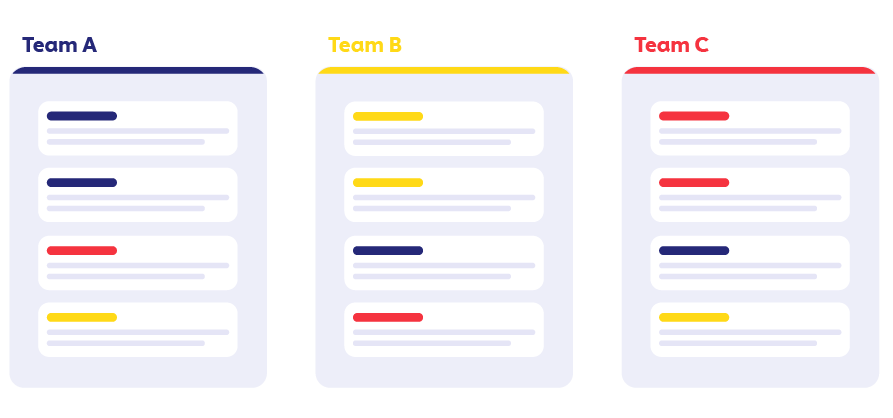
Deconstruction means breaking down a cross-departmental project in such a way that individual work packages/features/epics can be handled by different teams. Project managementProject ManagementProject management is the planning, steering, and monitoring of projects to achieve specific objectives within a given timeframe and budget. of this cross-departmental initiative is then responsible for orchestrating the implementation across relevant teams. At the same time, the product owners of the individual teams are instructed to prioritize the corresponding work packages. In this way, special “non-value stream” work packages are implemented in the teams.
Dedicated capacity
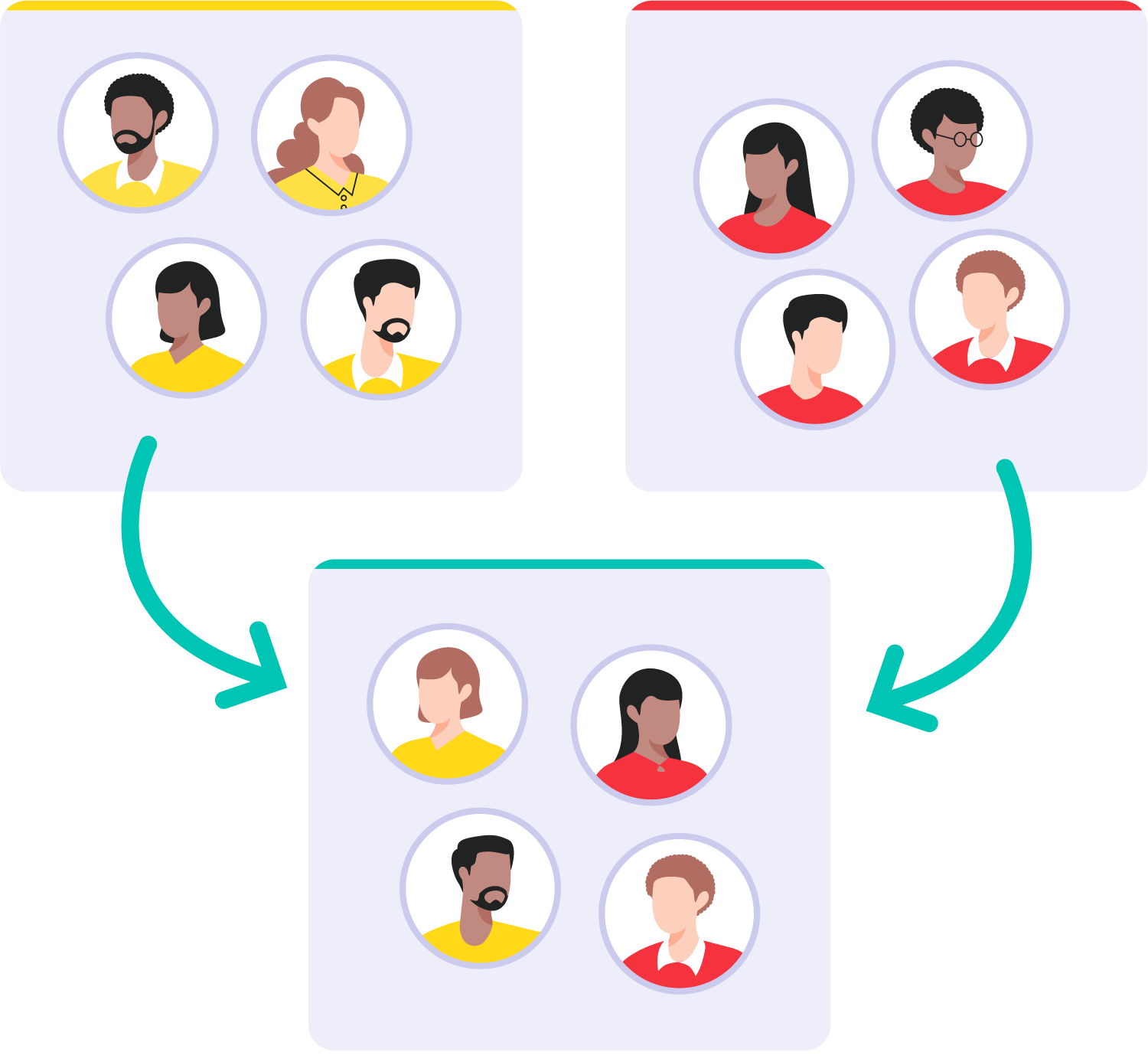
Instead of distributing the work among teams, capacity is decoupled from them, meaning that individuals are partially or completely removed from their teams to form a “classic” project team. Project management can then more easily control the sequencing of activities and reduce buffers and waiting times.
A Comparison of the Two Approaches
Deconstruction and distribution is generally preferred when:
- Work packages can be decoupled easily
- Project size is manageable such that project management can easily monitor work across multiple teams
- The project is not highly time-sensitive
On the other hand, dedicated capacities are generally preferred when:
- The deconstruction of work packages would be too complex
- There are many interdependencies
- The project is time-sensitive or has a fixed deadline
- Political factors favor the formation of a tightly knit team
In Both Cases: It’s All about the Overview
Whether you divide work into a team or put together a temporary team, the following factors will always be crucial for success:
- Clear objectives and motivated project managementProject ManagementProject management is the planning, steering, and monitoring of projects to achieve specific objectives within a given timeframe and budget., as always
- Unequivocal support and prioritization from upper management, political support – otherwise, the teams won’t be on board
- A clear overview of dependencies. You need to keep track of which activities depend on other resourcesResourceResources are all the people, places and things that you need to complete projects. The most important resource? Employees, of course! and which activities need to be prioritized to deliver to other projectsProjectA project is a time-limited undertaking with defined objectives and resources that delivers unique results and often includes complex tasks. or teams on time

Illustrative depiction of dependencies between different projects
How far along are you in your own agile transformation? How do you handle on company-wide initiatives? Stories in your teams? Dedicated capacity and scarce resources? Whether A or B (or even C!), we wish you success in all your upcoming projects/undertakings/business epics/features/big points… 😉 and are eager, as always, for your feedback.
Read Next